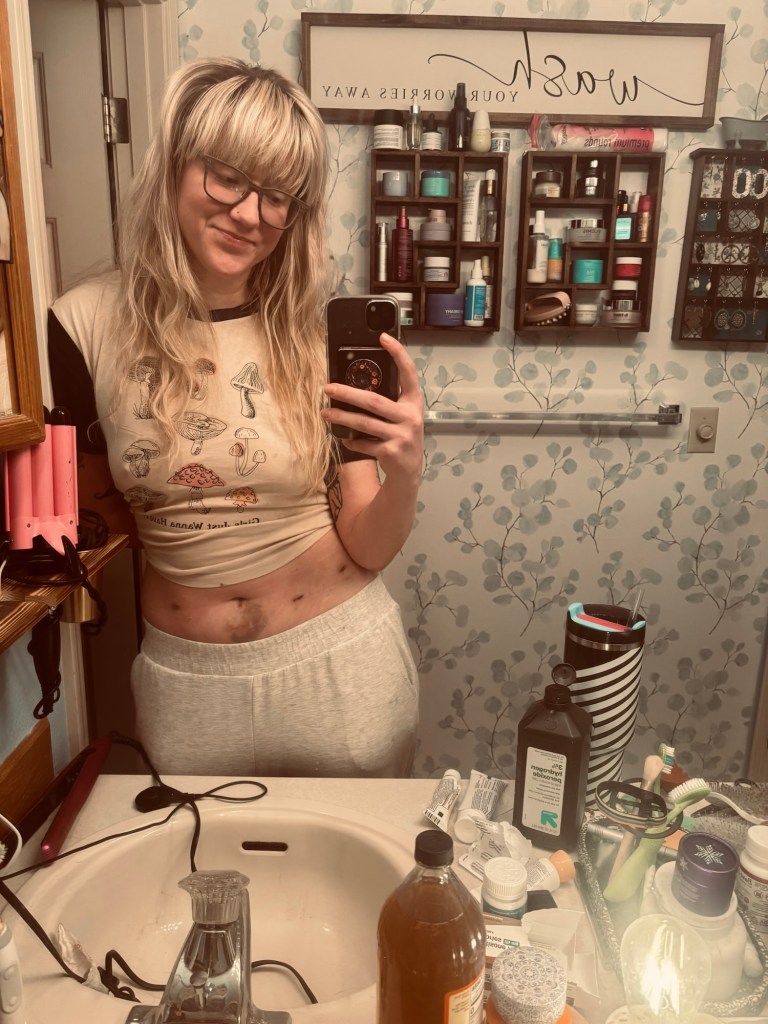
Why hello there, it’s me again – minus my uterus, fallopian tubes, cervix, lots of endometriosis lesions and scarring, and oh yeah, my significant other too (but we will get a little more into that later). First of all, I want to say thank you to anyone who has been invested or along for the ride of my endo & chronic illness journey. All of the love I received before and after my surgery was truly incredible, and it was a great reminder for me that we are never alone in this world, even if it might feel like you are sometimes.
My surgery was deemed to be a “very challenging but successful” surgery according to my surgeon, whom I greatly trust. It took a lot longer than initially expected due to the amount of endometriosis that was found once he was in there, and I will give you all the details of what had to be done directly from his operative report (with some simplified medical jargon). Keep in mind, this surgery occurred only about 2 years after my last excision surgery for endo, so this is a good example of how aggressive this disease can be in some women’s bodies, very similar to some cancers that spread.
Here are the details in chronological order of how it occurred during my surgery: There was severe, extensive, dense scarring endometriosis found throughout my pelvis. Both of my ureters were stuck to my peritoneum and had to be freed from the surrounding diseased tissue. A small piece of surrounding tissue was left adhered to my left ureter in order to avoid damaging it even further. A dark (usually means later stage/older) endo lesion was removed from my front pelvic space. There was a 3cm fluid-filled lesion with scar tissue adhesions stuck to my back pelvic area that was removed. There was white (usually means earlier stage or newer growth), scarred endo tissue throughout the back pelvic space. I had deep endo on the right side near my ovary, in addition to lesions on the right side of my rectum, that were all removed. Both of my ovaries were stuck in place due to endo scar tissue, so a lot of surgical work was done to free them from adhesions, which allowed me to keep my ovaries (this is a big win!). My sigmoid colon (part of the bowel) had endo adhesions on it, which were cut out. Disease was removed from my left uterosacral ligament (this part alone took about 45 minutes, which shows just how complex/deep the endo was). Endo was then also dissected from the rectovaginal (between the vagina and rectum) area of my pelvis. There was very dense scar tissue throughout my posterior cul-de-sac (the deepest pelvic space), which is one of the most common areas of pain for those with endo. The right side of this area had lesions with adhesions and was quite inflamed and thick per my surgeon. My rectal arteries were involved on both sides as well. Part of my bladder was stuck to my peritoneum and had to be freed. Towards the end of the surgery, another endo lesion was found in the front pelvic space and was removed. My surgeon made note in the operative report that this was an “extremely difficult and extensive” surgery, and also told my mom that it was one of the most challenging surgeries he has ever done when he came to speak with her as I was getting set up in the recovery room. When waking up from surgery, my mom told me all I kept saying over and over was how unfair it is that men don’t have to deal with endo, which honestly totally tracks. I say that on the regular, even without anesthesia in my system, so I can only imagine how unhinged my comments were as I was waking up from surgery (I don’t recall any of this).
I’m a little over 7 weeks post-op now, and I’ve been told by my surgeon and by others with similar stories that I should notice some relief around 6-8 weeks after surgery. I can confidently say I can notice a difference, but I wouldn’t say it’s a big difference so far. I wish I could tell you that I feel like a brand-new woman because I know that’s what a lot of people would love to hear, but I’d be lying to you. I’m trying to be patient with this. Considering that my surgery was quite extensive and a lot on my body, I might just need more time than others to feel a big difference. My surgeon feels confident that I will eventually experience some extent of relief just from the sheer amount of disease he removed. Less pelvic cramping and bloating is the biggest difference I’ve noted so far. I also have to keep in mind that endo/adeno are not the only chronic issues I’m dealing with – there’s also my POTS and Ehlers Danlos as well. Because of my EDS, I have a significant amount of pain in my groin and hips area. I think this contributes to my pelvic pain more than I had ever realized before, and now that I don’t have the cramping pains as much, I am noticing the EDS pain more. At my 6-week follow-up, my surgeon did tell me that since I’ve been dealing with this disease for so long, it may take a while for my nervous system and pain sensory channels to calm down now that my uterus and most of the disease has been removed. My nerves and pain reactors are used to firing off on all cylinders, so I guess it makes sense that they might need some extra time to remember how they are supposed to function, or at least how they used to function before the endo and adeno got so bad. Luckily, there are some therapies and options for things to help the nervous system and chronic pain, and I’ve been referred to an interventional pain management practice here in Anchorage to see how they can help, so more to come on that. It’s so hard to explain endo/adeno pain and fatigue to those who have never experienced it. What I want to say at this moment is endo warriors have felt pain that most people can never imagine, and all the while, we show up to work, put on a smile, and try not to be a burden to others. My surgeon was floored when I told him I didn’t take any of the post-op narcotics that he had prescribed to me. I told him, “I mean yeah, I was sore, but the post-op pain wasn’t anything compared to the pain I’ve been feeling for years,” and that brought tears to his eyes. Honestly, I’m not ever expecting to be completely pain free. I have other chronic illnesses going on, and pain is just a part of my reality. But hopefully, once my body calms down more, I will continue to feel improvement. There’s also always the chance of endo recurrence, but knowing there’s less of a chance of that because my uterus is now removed is somewhat comforting.
An important detail I want to point out to people is that when I had an extensive endo-specific pelvic ultrasound done prior to the surgery to look for deep infiltrating endo (DIE), nothing was found. The only thing listed on that report was that my ovaries were not sliding how they should, so we knew they were probably “stuck” from surrounding endo tissue or scarring. Some of you might be wondering, how does endo cause your organs to stick together? In a nutshell, endo creates chronic inflammation and bleeding outside the uterus. The misplaced tissue triggers repair responses in your body that create sticky fibrin and thick scar tissue that fuses organs together. But moral of the story is that no deep endo was seen on my ultrasound, and then when I had my surgery, my surgeon found DIE throughout my entire pelvis. I’ve had countless ultrasounds done over the years, even MRIs, and not one of them has ever been able to see my endo; not even this last one, which was an ultrasound protocol specifically designed to look for deep endo. Can you imagine how difficult this is for women? To have all of these awful symptoms, but then you get imaging done that essentially tells you “nothing to see here.” You then have to make the decision to undergo general anesthesia and exploratory surgery in hopes they find something that validates what you’ve been feeling for years. I had advanced, deep infiltrating endo covering much of my pelvis, involving my ureters, ovaries, rectum, bowel, pelvic ligaments, bladder, and major blood vessels. Some of these areas are high risk to operate on and require someone who is familiar with navigating their way around endo. If you think you might have endo, I cannot stress the importance of seeking out a specialist; someone that deals with endometriosis and adenomyosis frequently. A typical OBGYN is not going to be able to confidently identify and remove extensive disease like this, often from multiple organs.
Going into my surgery, I had a pretty clear head up until about a couple days prior, and then out of left field, my significant other told me he was all of a sudden “unsure about us.” And before any of you are like, “oh, she shouldn’t put her relationship info out there, blah blah blah,” this is relevant to my mindset before and after surgery, in addition to how it affected my healing process. I was not only dealing with having major surgery and losing my fertility, but I was also now dealing with my relationship going up in flames. My relationship was something that previously gave me a lot of comfort in regards to my decision to have a hysterectomy. We talked about the future, living together, the decision to not have kids etc., and we were both okay with that, which provided me with much relief. Now, that was being ripped out from under me right before my surgery (worst possible timing ever?), which left me with a lot of anxiety and muddled feelings. To be clear, I never had confused feelings about the surgery. I knew that was what I still wanted and what could give me the highest chance at improving my quality of life. But I was so perplexed on why my partner, someone who I considered to be my best friend and confidant, thought this was the best time to suddenly do this. It’s truly so mindboggling how someone you fiercely love can so quickly become a stranger that abruptly treats you like you’re nothing.
Before I go any further, if you came to my blog strictly to get an update on how my surgery went, then feel free to stop reading. Fair warning here – I’m going to get on my soap box about some stuff, particularly dating issues, feminism, and women’s health. Feel free to stick around if you’d like. Like I’ve said in previous blog posts, I do this blog because – 1. It is therapeutic for me, and I enjoy writing it. 2. To help others, whether they are struggling with feeling alone or with chronic illness or whatever it may be. 3. To spread awareness of chronic illness and chronic pain struggles. Anything I write below is an attempt to help someone else, or make them aware of something, or just help with validating how they may feel. Also, I’d like to put in a quote from my girl, Taylor Swift, regarding her exes getting upset for songs she wrote about them. “If guys don’t want me to write bad songs about them, they shouldn’t do bad things.” – Taylor Swift
The unexpected news from my partner that he was suddenly feeling “unsure” about us not only affected my headspace going into my surgery, it affected my healing post-op as well. I had no appetite because I was so anxious, and I wasn’t sleeping well because my mind was constantly worrying about what was going to happen with us. Everyone knows sleep and nutrition are two very important aspects of healing properly, not to mention anxiety itself impairs the healing process. My mind was unfortunately occupied with not knowing if my relationship was going to continue or not, when I should have been focused on healing and prioritizing myself. Someone who I considered my safe place made me wait through 2 weeks of anxiety and silent treatment while post-op just to hear that he wanted to end things, and by that time, I already wanted to end things myself. It made me furious because he obviously already knew that I struggle with anxiety, and he still chose to do this in the way that he did. No one that truly loved me, respected me, and cared about me would want me to suffer like that. I never received a single call from him while post-op to check on me (keep in mind, we were long distance, so this was truly the least he could do). If it wasn’t for my mom being with me and keeping me company, I think I would have really struggled mentally while post-op because it was just a lot for me to process all at once.
Looking back on things, I should have seen it coming. It’s interesting how clear things can seem once you’re out of the relationship, and you realize how much you put up with and how you made up excuses for him in your mind for the behavior he exhibited. Why do we, as women, date men for their potential so often, instead of what they are actually showing us? I’ve learned my lesson and won’t be making that mistake again. When someone shows me their priorities over and over again, I’ll believe them, instead of hoping that one day they will change. At the beginning of the relationship, I realized very quickly that my partner’s career was the most important thing in his life and probably always would be. I just hoped that eventually one day, I could at least be as equal of a priority as his career was, but time and time again, he showed me that I wasn’t, and I just kept on hoping that I would be someday. I think it’s important to note that I have a history of letting relationships go on for longer than they should if I feel like something is off. I hope and pray for change. I try harder and harder, for it to often be met with minimal effort from the other side. I am known to go “all in” in relationships, even if the other person doesn’t deserve it, because I love being in relationships. I love love! I think this is the case for a lot of women. It is in our nature to nurture something, not just give up easily. But I think it’s important for women to listen to their gut and base their decisions on what their partner is continuously showing them, not what they hope might happen one day. Let’s face it – people rarely change like we sometimes hope they will.
I had plenty of signs staring me right in the face that I was never going to be a priority in his life; I just didn’t want to pay that much attention to them because I hoped it would eventually get better, or that one day he would just “get it.” Every time I brought up that I felt like I wasn’t being prioritized, he acted like he understood what I was saying, yet his actions kept telling me that he didn’t. When one of my best childhood friends back home suddenly passed away in a tragic car accident, I asked him to stay the night with me because I didn’t want to be alone, but it became a big thing because there was a fire he would be missing out on, even though he wasn’t scheduled to be on shift. When he came home with me to Florida with the main purpose of meeting my dad who has stage 4 cancer, he was on his phone or listening to his radio out loud basically the entire time. When I asked for him to be present and attentive while hanging out with my parents and to turn his radio off, you would have thought I was asking something outlandish of him by the way he reacted. Why come visit my family if you are just going to stare at your phone or listen to your radio the entire time? We were on a completely opposite corner of the country, and he still couldn’t separate himself from his job. This is probably how it would’ve been with any vacation in our future as well. It would have been a constant cycle of him not being present with me and in the moment, causing me to feel unimportant and not prioritized, causing a fight, and so on and so forth. For someone that is on his phone constantly, you would think he would be pretty quick with replying to texts, but he would often go all day without texting me back. He could be sitting across from me at dinner, just the 2 of us, and not look up at me for 20 minutes because he was staring at his phone. When applying for the job that eventually caused us to be long distance, I found the job application sitting on his desk at work, and he had decided to apply for it after previously telling me that he didn’t want to move to that area. Instead of being truthful to me about it, he kept saying, “I just wanted to see what would happen if I applied,” even though I could tell he wanted it. When he got the job and decided to accept it, I played the supportive girlfriend role and packed up his entire kitchen for him and the majority of his clothes and never received a thank you. I did an extremely sketchy drive through Alaska and Canada to be with him for the holidays and never got a thank you for that either. At first, I admired the love of his career and his dedication to it, but I didn’t realize that it would constantly take priority over me every chance he got. Being in a relationship with someone who loves their career just as much as they love you, if not more, is one thing, but having to always take a back seat to their career is another beast. If I was having an emergency of my own, or having an endo flare for example, I have no doubt in my mind that he would have left me to go on a call if there was one, even if he wasn’t scheduled on shift. I love what I do too, and I have pretty much always wanted to be a nurse. But it will never become my entire life, and I know how to set boundaries. Family and loved ones come first, always.
If I thought the whole prioritization of his life was bad before he moved away, it got even worse once we were long distance. It doesn’t feel good to be the only one in the relationship trying to call the other or finding a good time to facetime. It doesn’t feel good to be the only one asking “so when do we get to see each other next?” or to be the one trying to plan a trip so you can have time together. It gets old quick, and the lack of effort becomes apparent very fast when you are long distance because you actually have to commit your time, and there are only so many ways of communicating when you’re not in person. I’m not a needy girlfriend; I don’t ask for much besides good communication, respect, empathy, quality time, and effort. When I asked for us to simply send a Valentine’s card to each other for Valentine’s Day this year, even that was met with moans and groans. When facetiming or talking on the phone, he would often be playing video games at the same time and would become irritated when I would ask for his undivided attention. Keep in mind, we would maybe talk on the phone once or twice a week; it’s not like we were talking all the time or every day. When I asked if he had read the latest blog post I had done, he said he pulled it up and it was too long for him to read (even though he’s constantly on his phone). He also said, “well I’ve basically been living this with you and know all of this stuff anyways, so…..”. Pardon my French sir, but NO THE FUCK YOU HAVE NOT. Nice try, but you will never understand what it’s like to have endometriosis, nor will you ever have to, so kindly sit the FUCK down and read my fucking blog post so you can possibly gain some sort of empathy for the condition and be a supportive partner for once.
I think it takes a special kind of cowardice and cruelty in dating to: pursue someone, make them fall for you, and make them believe there’s a chance they could be a priority in your life one day, when in reality, you had no real intention of ever doing that by the show of your actions. Then to have the AUDACITY during our breakup conversation to say, “my partner needs to realize sacrifices need to be made in order for a relationship to work with me,” was really something. Excuse me, but I’ve made sacrifices throughout our entire relationship. And when I asked him to name one sacrifice he made for us from his end, of course he wasn’t able to name a single one. The level of selfishness to expect sacrifices to be made from the female’s end but not be willing to make any yourself is quite bold if you ask me and not something I want to be involved in. The number of egotistical thoughts that must go through a man’s mind to say something like that to someone they “love” is wild to me. You might as well just say, “I am more important than you and so is my job, so if you want to be with me, then you just have to accept that.” Then to have him gaslight me by downplaying our relationship was also just the icing on the cake. Other things I was told during the breakup conversation that made me want to scream were, “I’m just not that into it anymore” and “I feel bad because I know how in love with me you are.” Sorry honey, no need to feel bad for me because this conversation solidified my feelings on how much better off I am without you and your self-centered behavior in my life.
It’s funny how when women stick up for themselves, things all of a sudden become a problem with certain men, but when we don’t question things and are compliant then there are no issues. As soon as I said, “well if you’re not going to try and put forth any effort into the relationship, then why should I?” something clicked off in him and suddenly he was “unsure” about us. It was like he was allowed to not try, but as soon as I said I wasn’t going to anymore, now it was suddenly a problem. I was treated as an option in his head throughout the entire relationship because that was easier for him than fully committing and prioritizing me. He chose to have one foot in and one foot out the whole time. No woman ever wants to feel like an option. We want someone that sees our worth and wants to go all in with us. Honestly, when I was given the silent treatment for 2 weeks post-op and left in the dark, with no calls to check on me and see if I was okay, I realized I was being completely abandoned in a time when I needed him the most. And if this was happening now, it would certainly happen again in the future. Friends and family, even acquaintances, were reaching out to see how I was doing more than my own significant other was, and that said a lot. I would’ve moved heaven and earth for him; I would’ve gone running to him for anything if he needed me to, but it was never the other way around. In the words of my girl, TS, I felt like my love was being tolerated, never celebrated the way it should be. Either you want me and are capable of committing to me, or you don’t and you’re not. It’s really that simple. He didn’t need 2 weeks of torturing me with silence to figure that out.
I’m an accomplished woman, despite all the pain I’ve endured over the last decade of my life, as are a lot of women with endometriosis. I have obtained my bachelor’s and master’s degrees in nursing. I’m not only a registered nurse, but a board-certified nurse. I volunteer within my community, have a heart for others, and I’ve served our military for almost 10 years (a combo of active duty & reserves). I’m a loving daughter, sister, dog mom, friend, & aunt; I’m sure as hell not going to allow any man to make me feel like I’m not worth their time, especially when I’ve gone through more physical pain than they could probably ever imagine, let alone handle.
Despite being so heartbroken throughout my initial post-op course, I was and still am so very thankful for all of the flowers, cards, prayers, and kind words that were sent my way. Even when your heart is breaking and life feels dark, you can still find so much to be grateful for and areas of light within the darkness. I’m also so grateful that he showed me this side of himself now instead of later, and before I ever picked up my life and moved to be with him (which is something he would’ve never done for me anyways).
There were so many lessons learned throughout this experience that I think many women would benefit from hearing:
- We get this one life here on earth. Our time here is too short to spend it agonizing over someone who doesn’t see your worth, or accepting things that are below your standards & what you deserve.
- Don’t alter your life for someone that continuously shows you that you aren’t a priority in theirs. I was the one that was going to have to completely uproot my life in order to be with him, and I sure am glad that the breakup happened before I did that.
- Trust God’s plan and the timing of your life. Or if you aren’t someone that believes in God or a higher being, trust that the universe brings to you what is meant for you.
- If you’re going to be with someone, be with someone that treats you as a priority in their life, not an accessory.
- Family and our loved ones will always be there, but your job/career might not be. To prioritize your job over those that love you is a mistake and a way I am not willing to live. When I am older and look back on my life, I want to be able to say that I built meaningful relationships with those that I spent my time with. I’m not going to say that I wish I would’ve spent more time working.
- Don’t let your envisioned hopes and dreams keep you from the reality of the situation. I loved the life I had envisioned for us in the future, and I think that’s part of what kept me in the relationship for as long I was.
- Don’t be afraid to be single until you find someone that truly deserves you. I enjoy my own company and always have. I don’t mind “being alone.” I realize this is harder for some, but I think it’s a good lesson. Don’t settle out of fear of being alone.
- Make sure you aren’t the only one who is trying in a relationship. As women, we often try really hard to make a relationship work. We like to see the good in people and the good in the relationship, but in reality, we shouldn’t be ignoring the red flags or making excuses for the other party. It’s easier said than done, since we often see what we want to see.
- If he is constantly on his phone, but never texts you back in a timely manner, that’s weird. If he is always taking pictures, posting pictures, or always looking at social media, but never posts pictures with you or anything about you, that’s weird to me as well. We all want someone that wants to show us off and is proud to be with us. If he’s not a social media person, then that’s different. But if he is, I’d think twice about that if I were you.
- One of the ways I have always received love the most in “love language” terms is words of affirmation, so the words someone says has always meant a lot to me. I’ve realized over the years that actions mean more and show how a person truly feels. People can bullshit you and say whatever they want. Sure, I still love words of affirmation, but if that is a strong love language for you as well, I’d just like to caution you to also pay attention to actions.
Regardless of how it ended, I know I can say I gave it my all and was myself throughout the entirety of the relationship. Do I have inner thoughts and fears that come up sometimes about finding someone else that accepts me for who I am and what is entailed in being with someone that has chronic illness that won’t ever be able to conceive? Yes, of course. The thought of having to start all over again with someone new one day is scary. But does that mean that you should settle and accept less than you deserve? Absolutely not. Imagine spending the rest of your life with someone who doesn’t prioritize you and doesn’t care about how they make you feel. To me, it’s worth it to be alone until you find the love that is right for you. Starting over can be scary, but settling is a much more daunting thought for me. Of course, I like the idea of finding someone I would enjoy growing old with and having that special person I could always count on, someone that knows me better than anyone else and looks at me like I’m the only person in the room. Who doesn’t want that? But I’m also not afraid to be alone until I find something that is worth possibly disturbing my peace for. If you didn’t deserve me in my pre-hysterectomy era, then you sure as hell don’t deserve me in my post-hysterectomy era. Also, frankly, I’m getting tired of introducing men to my sweet angel of a dog daughter that don’t end up deserving her short time on this earth.
Speaking of disturbing my peace; that seems to be what this modern-day dating world does to me. I have so many concerns with the entitlement that men, specifically white men, possess these days. Well, it’s not really “these days” either; that’s how it’s always been, and I’ll get more into that later on. But in all honesty, it is seriously difficult to find a man in the current dating world that: 1. Knows how to communicate. 2. Doesn’t have an ego and is humble. 3. Is capable of commitment & knows what he wants. 4. Isn’t entitled. 5. Believes in equality. 6. Isn’t always looking for the “next best thing.” 7. Is honest, trustworthy, & faithful.
I think technology has greatly affected how dating is now. I think some men in the dating world can’t help but wonder if there’s always something “better” out there for them because of the access to so many women on dating apps and social media, even though they might have someone amazing sitting right next to them. Receiving selfies or revealing photos from girls on snapchat, not to mention how huge the online porn industry is, gives men this instant gratification that one can easily get addicted to. In my recent relationship, after we had declared ourselves official, my partner thought it was still okay to be receiving selfies and photos of girls on snapchat when he had a girlfriend. It doesn’t feel great to have to ask your partner to delete these people still sending him photos seeking attention, and it would be nice if men would just take the initiative to do that themselves when they get into a committed relationship with someone. If you want to continue receiving attention that way, then fine, but just don’t get into a committed relationship then. Also, what is up with married men and men in committed relationships liking naked or revealing photos of women online? It’s weird, inappropriate, and disrespectful to your partner if you ask me. I guess if your partner doesn’t care then that’s one thing, but if they do and they mention how it bothers them and you still continue to do it anyways, then that says a lot about your character and commitment to your partner. I also had an issue with my ex liking and sharing videos with his friends in group chats, in which the videos/reels were either disrespectful to me as his partner because it was a revealing video of another woman or something, or it was a video/reel they thought was funny, but in reality, was disrespecting women in general. When bringing up my concerns he would say, “well, what do you want me to do, leave the friend group chat?!” And I would say, “no, but I just want you to understand how this makes me feel from my end and how the video is disrespectful to women,” but I never really felt like he understood, or cared enough to try. What you think is “funny” and what you talk about with your friends or populate your mind with says a lot about who you are as a human. I couldn’t help but get Donald Trump “grab them by the pussy” vibes. Sorry but “locker room” talk with your buddies isn’t an excuse for saying or liking sexist commentary. My ex also introduced me to something called the “Hot Crazy Matrix,” which is apparently a well-known thing in the male community, but I’d never heard of it. I won’t go too far into it because you can watch if for yourself if you Google it, but the basic lesson from it is that the hotter a woman is, the crazier she is, and the matrix tells you what women are marriage material or “unicorns” based on where they lie on the matrix. Honestly, the video is pretty funny if you get past the complete sexism of it, but the sad part is that I think a lot of men actually believe there is some truth to it.
Also, on another note, I think it’s cool to care about politics and what is happening in the world. It’s cool to have a stance on things and care about an issue that is important to you, even if we may not agree on things. When bringing up world issues I cared about or when I would get worked up about something political and vent to my partner, I could tell he just didn’t care. Not only could I tell, but he literally said so. He would say things like, “it’s never going to change, so why care?” or “if it doesn’t affect me or my job directly or the small town I work in, then I really don’t see a purpose in getting worked up about it.” Okay dude, but you should still care about some of this stuff, even if it doesn’t affect you directly. Can’t you see how others will suffer or are currently suffering? And you just don’t care? It was hard for me to understand. If anything, it just proved to be another example of a man being used to his privilege. I think some men are so used to their privilege and getting what they want, whenever they want it, that they have a very hard time with empathy and understanding the struggles of others.
I also think that the lack of empathy that men possess sometimes doesn’t allow for them to see past their own sexist biases, and women have to deal with these sexist biases, actions, and remarks every day. Just sitting here typing this, I can think of plenty of recent situations in which I saw something sexist on the internet or was dealing with a sexist man in person. For me, sadly a lot of these experiences have happened in the military. There’s the commander who can’t remember my name, even though I’ve done the bulk of the nursing work for the unit for almost 3 years now. There was the flight chief who told his female members directly that women don’t belong in the military. There was the medical director that targeted me as the new nurse on the unit that tried to outcast me and turn the other nurses against me by writing me up several times for stupid reasons. When I stood up for myself and didn’t take his shit, I was gaslit, and he tried to make me think I was making it a bigger deal than it was. I also once dated someone that would repeatedly make sexist comments that he thought were funny. One comment, for example, was “women drivers, no survivors.” Every time I heard him say this, I wanted to slap him across the face, but unfortunately, I knew doing so wouldn’t slap any sense into him either. The most recent experience I had was when I was in line about to board a flight. I decided to get in line when they said any active duty or veterans could board the plane because I wanted to snag some good space for my carry-on. I had my headphones in like I normally do in the airport because I avoid having small-talk conversations with people I don’t know as much as humanly possible, but that didn’t stop an older white man from continuously looking at me and asking if I was first class. He was obviously standing up there wanting to be the first to board, and he was clearly boarding with the first-class people, and I don’t think he liked that I got to be in front of him. I ignored him the first couple of times he asked me in hopes that he would get the gist and stop, but I guess that was wishful thinking. Since he continued to ask, I took out my headphones and said, “excuse me?” And he proceeded again with asking, “are you first class,” insinuating that I had gotten in line to board too early because there was no way in hell I was active duty military or a veteran because I’m a woman. When I told him I was boarding with the military, he just said “oh…,” and didn’t say anything else to me. What if I was first class? Why is that your business dude? How about you mind your own business, leave me the hell alone, and let the young, single woman traveling alone do her thing.
When it comes to understanding the struggles of others, specifically women & advocating for their own health issues, I highly suggest reading the book All in Her Head by Elizabeth Comen, MD. This book goes through the history of women’s healthcare, starting from the very beginning when men styled themselves as authorities over the female species and how it still affects modern age healthcare for women today. I’ve never read a more eye-opening book; one that made me feel validated in so many ways, while also infuriating me at the same time. I know not everyone has the time to read this book or may not even want to, so I feel compelled to share some points in the book that really moved me, sometimes in a disturbing kind of way, sometimes in a sad way, sometimes in an empowering way. Feel free to skip over this part of the blog post if you’re not interested, but you should care, seeing that it affects half of the world’s population.
- In the late 1400s, with the help of beliefs from the Catholic church, tens of thousands of women were persecuted and killed during “witch hunts” and accused of witchcraft, while many of them were actually healers like midwives and those practicing herbal medicine. This marked the beginning of a long effort to push women out of medicine, labeling their healing practices as dangerous and immoral, while the Catholic church believed the real cure for illness was confession and prayer. As medicine became more scientific over time, women were increasingly excluded, not just from practicing medicine, but from studying it as well. By the 20th century, medicine was a male-dominated field, and even today, even though more women are practicing medicine, gender bias still strongly persists. Women are underrepresented in research, and medical knowledge and treatments are based on the male body and reflect a male-centered perspective. Yet, evidence shows women providers spend more time with their patients, possess more empathy, connect with their patients better, and studies even show that women operated on by male surgeons have significantly worse outcomes, including death, than when operated on by a female surgeon. Male physicians are also more likely to interrupt their patients sooner than a female physician.
- In the late 1800s – early 1900s, the mindset of the time was that doctors spoke as urgently about the risks of women being masculinized by exercise as they did about its supposed threats to their health, even the ones who believed that physical activity could be beneficial to women.
- In the 1920s & 1930s, Olympic officials and physicians would visually inspect any woman they were suspicious of (meaning if she appeared too masculine that they were questioning her sex). In 1948, the International Olympic Committee began to require women prove their gender via a doctor’s note. This allowed the normalization of “sex testing” by other sporting organizations including the Pan-American Games as well. In 1967, a female athlete described the “testing” behind eliminating a woman from competition if she didn’t pass the official’s standards. She stated that officials lined athletes up outside a room where doctors were sitting in a row behind desks, and they had to go in and “pull up your shirt and push down your pants. Then they just looked at you while you waited for them to confer and decide if you were ok. While I (she) was waiting in line I (she) remember one of the sprinters, a tiny, skinny girl, came out shaking her head back and forth saying, ‘well, I failed, I didn’t have enough up top. They say I can’t run, and I have to go home because I’m not big enough’” (up top).
- The BMI chart that compares height and weight to determine someone is underweight, normal, overweight, or obese is often used in medical settings, but it overlooks just as much as it reveals, especially for women. Women carry more fat than men do, but we also carry it differently as well, making the BMI chart a blatantly ineffective measure when it comes to what is happening inside of women’s bodies.
- In the late 1800s, cardiac medicine was designed with the male patient in mind, while women presenting with heart complaints were understood to be suffering from neurosis, anxiety, & hysteria. Heart attacks were linked to maleness and masculinity, while women were said to be suffering from “pseudo angina.” Ironically, anxiety and social stress were still described as serious risk factors for a heart attack at the time, but only in men.
- “When doctors conducted the first medical trial to establish a link between cholesterol and heart disease in 1982, their data set included 12,866 men and no women. In 1995, the seminal study establishing that aspirin could reduce the risk of heart attack included 22,000 men and, again, no women.” The first government initiative to study heart disease in women specifically wasn’t until 1994, and since then, the scientific community has been frantically playing catch up when it comes to treating women’s hearts. A woman suffering from heart disease will still receive far less aggressive treatment than a man today. The EKGs and cardiac testing equipment used to diagnose are still calibrated to the body of a standard male, and the doctor reading those results is in all likelihood a man because only 13% of all practicing cardiologists are women. Ventilators are also typically calibrated to male patients, which can make it harder for a provider to determine if a woman is receiving the proper volume of oxygen while on a ventilator.
- Today, 1/3 of women will develop heart disease at some point in their lives. For 1/5 of women, it will be the thing that kills her. That’s not just more than breast cancer; it’s more than all cancers, of every type, combined. A hundred years after doctors declared that women’s heart failure is all in their heads, it is their leading cause of death, and still often overlooked until it’s too late.
- Back in the day, physicians blamed women for the spread of disease, particularly their vaginas. There was the fear that having sex with an “unclean” woman would cause a man’s dick to fall off. Noticeably absent from the literature back then is any sense that women could also suffer from STDs, or that men could have any hand in spreading them as well.
- Mary Mallon, also known as Typhoid Mary, is the well-known Typhoid carrier and spreader of her era, even though the most infectious typhoid carrier of the era was a man named Tony Labella, who was likely responsible for almost double the number of cases that Mary could be traced to. By the time she died, she had been forced to live in quarantine for more than 26 years.
- In the early twentieth century, research built a consensus in the medical community that a promiscuous woman could be identified by the size and shape of her genitals.
- The American Plan of the twentieth century – vast numbers of women were kidnapped, imprisoned, and forcibly treated with dangerous drugs in the name of “common good.” Medical authorities stalked, arrested, and imprisoned women who were engaged in activities that marked them as “likely STD carriers.” These activities included sitting alone, changing jobs, or even just “looking suspicious.” A positive test for a STD resulted in the woman getting sent to a government camp where they were forced to accept drugs, and if they failed to be properly ladylike, they were often beaten, doused with cold water, thrown into solitary confinement, or even sterilized. What started as a program aimed at prostitutes due to the alarming spread of STDs among members of the US military during World War 1 ended up expanding to encompass the entirety of our nation of “foul women.”
- In the 1930s, Lysol ads were not only promoting their products as cleaning agents; they were promoting them as douching agents as well, with ads that implied that women who didn’t clean their private areas with industrial-grade disinfectant would become sexually repulsive, causing their husbands to not want to have sex with them.
- HPV, an STD that is thought to be responsible for 90% of cervical cancers, was tainted by the revelation that doctors were only recommending the HPV vaccine to female patients, even though men spread it just as easily. It’s not only been linked to cervical cancers, but also head, neck, penile, and anal cancers too.
- The FDA’s Office of Good Clinical Practice has been calling for gender parity in clinical trials since 1993, yet scientists have been reluctant to follow those guidelines, due to the misguided belief that female subjects and their hormone cycles make clinical trials “too messy.”
- Women who shared stories of menstrual side effects related to receiving the Covid vaccine when it first came out were mocked, ridiculed, and often had their social media accounts suspended for spreading “misinformation.” PolitiFact, in response, wrote “there is no data linking vaccines to changes in women’s cycles or fertility.” This was not because the data didn’t exist, but because researchers had simply not bothered to collect it. Women were present as subjects in the Covid vaccine clinical trials, but any data related to their cycles was completely left out of the equation, and they were essentially studied as men. Over a year later, it was finally acknowledged that the Covid vaccine could, in fact, cause menstrual disruptions.
- In the later 1800s and early 1900s, many doctors believed women with “nervous disorders” or “hysteria” should be sent to asylums for “treatment.” Because of this, a large number of women were institutionalized, often based on claims made by their husbands or fathers, not because of true mental illness. Among the many reasons for committing these women were complaints of depression, menopause, reading too much, religious enthusiasm, sexual behavior (either too much or too little), general disobedience, or even to allow a philandering husband to pursue other affairs without worry of being found out. Men close to these women initiated these claims, and then allowed the system that benefited them to control or silence these women. This not only benefitted controlling husbands or fathers, but also allowed doctors to experiment on these patients without their given consent.
- One particular doctor of the early 1900s, Dr. Henry Cotton, believed women with “insanity” could be cured by removing teeth, usually all of them. If that didn’t work, he usually progressed to removing her tonsils, gallbladder, stomach, spleen, cervix, colon, and ovaries (he saved the ovaries for last typically and recommended they only be removed in “extreme” circumstances). Despite others bringing up concerns about his methods, he got away with extracting his patient’s teeth and organs in the name of science for more than 20 years, probably because of his reputation as a groundbreaking scientist.
- The rise and fall of lobotomies marked a turning point in women’s medical history because it was more or less the last ideology that advocated for surgical solutions to “behavioral problems.” Not surprisingly, lobotomies were disproportionately used on women because the procedure was labeled as a “cure” for mental problems like nervous disorders, hysteria, and deviant thinking. Lobotomies were done for all the same reasons women were committed to asylums, and the people usually most pleased with the results of a lobotomy on a woman were often not the patient themselves but her husband.
- Alzheimer’s disease afflicts twice as many women as men, yet only 12% of funding for research goes to projects focused on women.
- Every human body, regardless of sex, is internally flooded in hormones. Every human being produces the sex hormones associated with both male and female bodies, yet somehow only women’s hormones have been unfairly blamed for making us seem emotional, unpredictable, or even unfit for certain roles. A man with high testosterone is often understood as a warrior, a stud. A woman with too much estrogen, on the other hand, is just crazy. And even though science eventually came to understand that all hormones are present in all bodies, the “bitches be crazy” narrative hasn’t so easily been set aside.
- This isn’t in Dr. Comen’s book, but I think the statistics on intimate partner violence and sexual assault paint a clear picture that men are, in fact, the more irrational thinkers (if Donald Trump’s Twitter isn’t enough proof for you). While I think some of this can be attributed to mental illness, I think it also has to do with men being used to their privilege and not knowing how to handle rejection and not getting what they want. Men are so opposed to going to therapy for some reason that many of them will never understand how to process their feelings, which instead, results in outbursts, violence, and aggression. Statistics in the U.S. show that nearly 1 in 3 women are killed every single day by a current or former intimate partner. In cases of domestic homicide-suicide, 91% of the perpetrators are men, often using firearms. A sexual assault occurs in the U.S. every minute, with 1 in 4 women experiencing rape in their lifetimes. 91% of sexual assault victims are female.
- One of the doctors I currently work with is one of the most dramatic human beings I’ve ever met. He consistently talks down to the other women and nurses in the office, yet never gets in trouble for it. I have made my concerns and frustrations on this clear to management, who claim they have talked to him about this, yet he still continues to act this way. If a patient is 10 minutes late, he throws a fit and says it ruins his whole clinic day. Okay sure that’s possible, but it is what it is, and you still need to go see the patient and be professional. If I overbook his schedule because I don’t have another choice, he will complain about it the entire day. When we disagree on something and I try to explain my perspective, it goes in one ear and right out the other. The dramatics are through the roof to the point that it makes everyone else around him miserable, and I guarantee you, if that was a woman in the workplace, that behavior would not be tolerated.
- This isn’t in Dr. Comen’s book, but I think the statistics on intimate partner violence and sexual assault paint a clear picture that men are, in fact, the more irrational thinkers (if Donald Trump’s Twitter isn’t enough proof for you). While I think some of this can be attributed to mental illness, I think it also has to do with men being used to their privilege and not knowing how to handle rejection and not getting what they want. Men are so opposed to going to therapy for some reason that many of them will never understand how to process their feelings, which instead, results in outbursts, violence, and aggression. Statistics in the U.S. show that nearly 1 in 3 women are killed every single day by a current or former intimate partner. In cases of domestic homicide-suicide, 91% of the perpetrators are men, often using firearms. A sexual assault occurs in the U.S. every minute, with 1 in 4 women experiencing rape in their lifetimes. 91% of sexual assault victims are female.
- “Until quite recently, virtually all the medical literature agreed that menopause was a serious problem. But it wasn’t a problem because of the debilitating symptoms if inflicted on women; it was how it impacted their behavior in ways that were irritating to men.” – Dr. Comen
- In the 1960’s, Dr. Robert Wilson (a prominent endocrinologist at the time) said that menopausal women with hormone replacement therapy (HRT), “will be much more pleasant to live with and will not become dull and unattractive.” Somehow, like many other aspects of women’s health at the time, treatment for menopause became about making women more pleasant company for men, not alleviating women’s suffering.
- The clitoris was virtually ignored by the medical community for nearly 2 millennia. Between the first and fifteenth centuries BCE, one of the few documents to address the existence of the clitoris is the 1486 Malleus Maleficarum, which described it as the “devil’s tear” and advised that any woman who had one could be assumed to be a witch. The female external genitalia was also termed “pudenda,” which is a Latin word that means “things to be ashamed of.”
- “Indeed, this organ, inessential to reproduction and yet utterly crucial to a woman’s sexual function—and which doctors have largely treated as either insignificant or sinister when they weren’t congratulating themselves for discovering it—serves in many ways as an avatar for the uniquely difficult relationship that the medical systems has, and has always had, with women’s sexual health. Despite the initial assessment of women’s anatomy as inherently inferior, inverted, and other, medicine was ultimately forced to recognize the importance of the parts of a woman that produce eggs and hormones, maintain a pregnancy, and facilitate the birth of a child—all of which have long been treated as a woman’s biological destiny, her sole reason for being. But the clitoris represents an anatomical wild card: its very existence suggests that women can enjoy sex on its own merits, not just as a means to motherhood.” – Dr. Comen
- Even medical textbooks today still don’t address the physical diversity of women’s genitalia. A recent study of four medical anatomy books that have been in continuous use for the past 200 years found that they included only a single image of the vulva, a drawing of what is colloquially known as a “Barbie vagina.”
- For most of human history, female reproductive health was a woman’s issue and a woman’s territory, meaning pregnant women were tended to by midwives. Midwives were the heirs to hundreds of years’ worth of knowledge about menstruation, conception, pregnancy, childbirth, and postpartum care. As medicine formalized in the eighteenth and nineteenth centuries, midwives were increasingly being sidelined and scorned by the changing system as freshly credentialed men started taking their place. Doctors in the mid-1800s took over the duties of female midwives and declared themselves the founders of a brand-new medical specialty, which they called gynecology.
- During a period in the 1800s, women with a healthy sexual appetite became known as nymphomaniacs, and some physicians sought to “cure” this by surgically removing the female’s clitoris. Some doctors also advocated for clitoridectomy to prevent women from masturbating, which they believed would eventually lead to paralysis, blindness, and death.
- Vaginismus, a painful contraction of the vaginal muscles that makes sexual intercourse excruciating, was treated with varying degrees of seriousness by doctors in the 1800s. The physicians that did “treat” vaginismus were noted to view the condition less in terms of the misery is caused their female patients and more in terms of the frustration
isit caused their husbands. In one shocking case study, the solution a doctor had was to drug his patient so that her husband could have sex with her unconscious body. When doctors attempted to treat vaginismus, it was generally from the perspective of making the patient sexually accessible, rather than healthy. - “Consider endometriosis, one of the most crippling and least understood conditions affecting women’s reproductive health, which a recent historical view by a team of gynecologists at Stanford calls ‘one of the most colossal mass misdiagnoses in human history, one that over the centuries has subjected women to murder, madhouses, and lives of unremitting physical, social, and psychological pain.’” – Dr. Comen
- A woman with endometriosis who seeks care for fertility issues will receive a diagnosis twice as fast as a woman who seeks help for painful periods. Why is it so hard to believe women’s pain? Why does the ability to have a baby trump constantly living in pain?
Well, if anything is obvious to you, it’s probably that having endometriosis and adenomyosis has made me even more of a feminist than I already was. I really don’t understand why the term feminist is looked down upon by some. Feminism is literally just the belief in and advocacy for political, economic, and social equality of the sexes. 1 in 10 female-born people have endo. Let’s be honest; the number is probably far higher because millions of women are walking around living with endo not diagnosed, whether it’s because they have “silent endo”, or they don’t have access to medical care, or they are still in the 7-10 year process of getting diagnosed. Would there be a cure by now, or at the very least, more research done, if this disease affected 200 million men? I 100% believe there would be. I think if less time had been spent on women’s “hysteria” and how we were basically demonic creatures back in the day, then some of those views wouldn’t have made their way into modern day medicine, and maybe we would have taken women more seriously and know much more about endo by now. But instead, men were focused on figuring out how to keep women from masturbating, how to cure us from “hysteria,” and throwing us into insane asylums, many at the hands of their own husbands in order to control them. And that right there is a reason why feminism is so important. Even still today, studies being done on endo show sexism and are unbelievably far from what we need to be focusing on. There is literally a study from 2013 called: Attractiveness of women with rectovaginal endometriosis: a case-control study. One from 2018 is titled: How does endometriosis affect the sexual satisfaction of men? As more and more celebrities and well-known people come forward detailing their experiences with endometriosis, I am happy with the awareness and the possibility of more funding for research, but I can’t help but also think about all the women out there who are living with pain that have no platform or voice to speak out and ask for help. Or those that live in healthcare deserts, or those that will continue to be gaslit and silenced when they do seek help for the symptoms they are experiencing. And why is it that I’ve seen so many ads and commercials for Peyronie’s disease and medication that is available for it, yet I’ve never seen a single ad or commercial for endometriosis? If you haven’t heard of Peyronie’s disease, it’s a condition where scar tissue develops in the penis, which can lead to pain, abnormal curvature and shortening of the penis, and erectile dysfunction. It affects around 1 in 10 men, just like how endo affects 1 in 10 women, yet the representation of the diseases are not even close to being similar. I’m not saying Peyronie’s disease isn’t a legit concern and probably something difficult to live with for a man; I’m just saying endometriosis deserves equal time and attention. Imagine waking up in a body that looks capable but behaves completely unpredictable. Imagine being complimented on your body or how healthy you look, while you’re silently calculating how many more minutes you can stand, how much farther you can walk, and whether today is going to be a day in which your body punishes you for trying. A chronic pain patient can function with a pain level that would incapacitate any other person, but pretending you’re not in pain to keep other people around you comfortable takes a lot of energy; energy that those with endo or chronic illness barely have at all. This is why it can seem like those dealing with chronic pain isolate themselves, avoid people, or frequently cancel plans.
I think it’s important to note that most women with endo do not post their struggles. Many are suffering silently. I do this blog, not only as a sort-of therapeutic diary for myself, but to spread awareness about endo and let others know they are not alone if they are struggling. There are some social media influencer gals out there that have large platforms and talk about endo and share their experiences, but for the most part, women are out there searching for answers and trying to find other people they can relate to. As much as my friends and family are there for me, no one truly understands the pain of endo unless you’ve actually lived it. A lot of people doubt you actually. Because they see you post a selfie of you smiling, or they see you go out to dinner with your friends, or even go on a vacation, but little do they know, some days you are just trying to muster up enough energy to get through the day. Many of you look at my social media and see all of my Alaska adventures because that’s what I want you to see. I don’t post pictures or videos of me in a searing hot bath for the fourth time in one day because that’s all that helps me feel better and all that takes the pain away for a bit. I don’t post myself sitting on the toilet, shaking and in pain, wondering if this bowel movement is going to be worse than the last and if blood is going to fill the toilet again. I don’t post videos of myself rocking back and forth, breathing as if I’m in labor, when the cramping and pelvic pain is so severe. I don’t post myself crying because all I want to do is take my dog on a walk because that’s what she deserves, but I can’t get out of bed from fatigue or the pain is too much. I don’t post myself struggling to go up and down the stairs in my house when my joint pain is debilitating. I don’t post myself ordering DoorDash for dinner every night some weeks because I don’t have the energy or can’t stand up long enough to cook. I don’t post myself going to my dozens of doctor appointments and trying to keep my schedule straight. This is just my little foot stomp that I always make, that you never know what someone is going through. Every single time I make one of these blog entries, I have someone reach out to me that feels validated by it, or someone that is experiencing chronic pelvic pain and has questions for me. Some of them I personally know, some of them I don’t. Many people reached out to my family and I after my last blog post prior to my surgery because I mentioned how both of my parents received cancer diagnoses last year. My parents hadn’t told many people because that’s just not who they are. Some people are more private than others. Some don’t want any extra attention. Everyone is different, and someone might not choose to go about things the same way you would. But please know, to anyone who reached out and offered kind words and prayers for my parents, I know they appreciated it more than you know.
Speaking of my dad, maybe one day I will find someone that prioritizes me the way he has prioritized me my whole life. He has honestly set the standard for me in that category. It’s funny; over the years, I have developed some very different political views from my dad, but I have never once doubted his love for me or that our different views on some issues would ever make him love me differently in any way. When I look back on my life, he has always been there, even when I did things so out of character for me, things I was so ashamed of, things I can’t even explain why I did them; he never once made me feel judged and only cared about my wellbeing. In moments of high anxiety or times when I’ve had panic attacks, he stays on the phone with me and calms me down. When my mind can’t stop racing and I just need to feel that someone is there, he stays on the phone with me, even if we aren’t saying anything. When I was living in Jacksonville during college and got in my first and only car wreck, he was my first call after the police, and he immediately drove the 2 hours to come see me. When I was stationed at Eglin AFB in Florida and was having a depressive episode, he drove 7 hours to come stay with me. He sat across from me at breakfast when he came to see me and asked how I was feeling, and when I said “I just feel nothing” and started crying, I knew he wouldn’t go back home until I felt like I was okay. He has been my go-to guy since day one. The one who mooned my brother and I to make us laugh when we were being little shits when my mom was trying to get a good picture for our Christmas card. The one who threw us into the pool at our house for the first time, as soon as it was done being built. The one who was swing dancing with me at a daddy daughter dance in elementary school and took a giant blow to his legs when he picked me up to swing me, and instead of openings my legs, I kept them straight together and ran them right into him. The one who was my egg toss partner for Easter every year and my tennis partner against my brother and my mom. When I was little, he was the one who would sleep in my bed with me or stay up in the living room watching TV on nights I was scared and couldn’t fall asleep. He’s the one who does the blessing and prayer at every family dinner. As I got older, he was the one who would stay up late waiting for me to get home at night, so he knew I made it home safely (and probably to make sure I got home by curfew). The one who has picked my brother and I up from the pub in town when we couldn’t drive home (and took us to Wendy’s on the way home). The one I get my stubbornness from. The man who proudly walked side by side with me on the football field during the presentation of homecoming court my senior year of high school. The guy who proudly watched me march during my Air Force Officer Training School graduation, even though I know his heart hurt that I might be far away from home one day. He is the guy who grew up with nothing, made something of himself, and has worked for everything he has. He put my brother and I through college without ever asking for anything in return. One of the most generous people I know; the kind of guy who donates generous amounts of money to the YMCA (among other things) because that’s where he was able to have fun for free growing up. He’s the kind of dad that always says “I love you” before hanging up a phone call. I know there are good men out there because I know my dad. And until I find someone of his caliber, I’m honestly just not interested. As much as I hear my coworkers complain about their husbands and their lack of effort, I’m honestly not even sure if marriage is for me. I guess if I find that special person one day, I might think differently. Previous versions of Sarah would have accepted less than she deserves, but not the Sarah I am now.
Wow, well if you’ve stuck out this blog post until the end, then props to you, and thank you for doing so. It seriously means so much to me. These last couple of months have been a lot for me between my surgery, recovery, my breakup, missing out on work, and worrying about my parent’s health. Oh yeah, I also had a breast MRI due to being high risk for breast cancer, and a 7mm lump was apparently seen in my right breast, so I had to do a breast ultrasound. Then, they had trouble seeing the spot on the ultrasound, so they ultimately told me that I will need to have another breast MRI done in 6 months. So yeah, it’s been a lot, and there have been a couple times where I thought I might crack and have some sort of a breakdown, but I haven’t. I owe that to my wonderful support group in my friends and family. I’m also REALLY trying to keep a positive mindset and attitude, which I think makes a world of difference. I have realized the importance of reframing the way I think about things in my mind in a more positive way. I think I’m also just learning to trust the timing of my life, and that whatever God has planned for me, will be.
Peace & love,
Sarah
 Tolbs Says
Leave a comment